
7.3 Other Useful Tests of Significance#
Beyond comparing population means, we often need to test hypotheses about variances or about how well a model fits data. This section introduces F-tests for comparing variances and χ² (chi-square) tests for assessing model fit.
7.3.1 F-Tests and Standard Deviations#
Motivation#
Before using a pooled t-test (Section 7.2.2), we assumed the two populations have equal variances. But is this assumption reasonable? The F-test helps us decide.
More generally, F-tests compare variability:
Do two populations have the same variance?
In ANOVA, do group means explain significant variation? (Chapter 8)
In regression, are predictors useful? (Chapter 13)
Testing Equality of Variances#
Setup:
Population 1: variance \(\sigma_1^2\)
Population 2: variance \(\sigma_2^2\)
Sample 1: size \(N_1\), sample variance \(s_1^2\)
Sample 2: size \(N_2\), sample variance \(s_2^2\)
Null hypothesis: \(H_0: \sigma_1^2 = \sigma_2^2\) (equal variances)
Alternative hypothesis: \(H_1: \sigma_1^2 \neq \sigma_2^2\) (unequal variances)
The F-Statistic#
The test statistic is the ratio of sample variances:
By convention, we put the larger variance in the numerator, so \(F \geq 1\).
Under \(H_0\), this statistic follows an F-distribution with:
Numerator degrees of freedom: \(df_1 = N_1 - 1\)
Denominator degrees of freedom: \(df_2 = N_2 - 1\)
We write this as \(F \sim F(df_1, df_2)\).
Properties of the F-Distribution#
Always positive (it’s a ratio of variances)
Right-skewed
Shape depends on both degrees of freedom
Mean \(\approx 1\) when \(df_2\) is large
Decision Rule#
For a two-sided test at significance level \(\alpha\):
Method 1: Compare to critical value
Reject \(H_0\) if \(F > F_{\alpha/2}(df_1, df_2)\)
(Since we put larger variance in numerator, we only need upper tail)
Method 2: Use p-value
Compute p-value \(= 2 \times P(F(df_1, df_2) > F_{obs})\)
Reject \(H_0\) if p-value \(< \alpha\)
Important
Practical Note: The F-test is sensitive to non-normality. If your data is not approximately normal, the test can give misleading results. When in doubt, use Welch’s t-test (Section 7.2.3) which doesn’t assume equal variances.
{admonition} Example: Comparing Measurement Precision Two lab technicians measure the same quantity multiple times:
Technician A: \(N_1 = 10\) measurements, \(s_1^2 = 4.5\)
Technician B: \(N_2 = 12\) measurements, \(s_2^2 = 2.1\)
Test if their measurement variances differ at \(\alpha = 0.05\).
Step 1: Set up hypotheses
\(H_0\): \(\sigma_1^2 = \sigma_2^2\) (equal precision)
\(H_1\): \(\sigma_1^2 \neq \sigma_2^2\) (different precision)
Step 2: Compute F-statistic $\(F = \frac{s_1^2}{s_2^2} = \frac{4.5}{2.1} = 2.14\)$
(Technician A has larger variance, so it goes in numerator)
Step 3: Degrees of freedom
\(df_1 = N_1 - 1 = 9\)
\(df_2 = N_2 - 1 = 11\)
Step 4: Critical value For \(\alpha = 0.05\) (two-sided), we use \(\alpha/2 = 0.025\): $\(F_{0.025}(9, 11) \approx 3.59\)$
Since \(F = 2.14 < 3.59\), we fail to reject \(H_0\).
P-value \(\approx 2 \times 0.12 = 0.24\)
Conclusion: At \(\alpha = 0.05\), there is insufficient evidence that the technicians have different measurement precision.
7.3.2 χ² Tests of Model Fit#
Motivation#
The chi-square (\(\chi^2\)) test assesses how well a theoretical model fits observed data. Common applications:
Goodness of fit: Does data follow a hypothesized distribution?
Independence: Are two categorical variables independent?
Homogeneity: Do different populations have the same distribution?
We focus on the goodness-of-fit test here.
The Goodness-of-Fit Test#
Scenario: We observe data falling into \(k\) categories. We have a model that predicts the probability of each category.
Setup:
\(k\) categories
Observed counts: \(O_1, O_2, \ldots, O_k\)
Total observations: \(N = \sum_{i=1}^k O_i\)
Model predicts probabilities: \(p_1, p_2, \ldots, p_k\) where \(\sum_{i=1}^k p_i = 1\)
Expected counts under model: \(E_i = N p_i\)
Null hypothesis: \(H_0\): Data follows the model (observed counts match expected counts)
Alternative hypothesis: \(H_1\): Data does not follow the model
The χ² Statistic#
The test statistic measures discrepancy between observed and expected:
Key features:
Each term is non-negative
Large values indicate poor fit
If \(O_i \approx E_i\) for all \(i\), then \(\chi^2 \approx 0\)
Under \(H_0\), this statistic approximately follows a chi-square distribution with degrees of freedom:
where:
\(k\) = number of categories
\(p\) = number of parameters estimated from data
Often \(p = 0\) (model is completely specified), so \(df = k - 1\)
Decision Rule#
For significance level \(\alpha\):
Reject \(H_0\) if \(\chi^2 > \chi^2_{\alpha, df}\)
Or equivalently, reject if p-value \(< \alpha\), where p-value \(= P(\chi^2(df) > \chi^2_{obs})\)
Note: This is a one-sided test (we only reject for large \(\chi^2\))
Requirements for Validity#
For the chi-square approximation to be valid:
All expected counts should be \(\geq 5\) (some sources say \(\geq 1\))
If some \(E_i < 5\), combine adjacent categories
{admonition} Example: Testing if a Die is Fair Roll a die 60 times and observe:
Face |
1 |
2 |
3 |
4 |
5 |
6 |
|---|---|---|---|---|---|---|
Observed |
8 |
12 |
9 |
11 |
13 |
7 |
Test if the die is fair at \(\alpha = 0.05\).
Step 1: Set up hypotheses
\(H_0\): Die is fair (\(p_i = 1/6\) for all faces)
\(H_1\): Die is not fair
Step 2: Expected counts If fair, each face should appear \(E_i = 60 \times (1/6) = 10\) times
Step 3: Compute χ² $\(\chi^2 = \frac{(8-10)^2}{10} + \frac{(12-10)^2}{10} + \frac{(9-10)^2}{10} + \frac{(11-10)^2}{10} + \frac{(13-10)^2}{10} + \frac{(7-10)^2}{10}\)$
Step 4: Degrees of freedom $\(df = k - 1 = 6 - 1 = 5\)$
Step 5: Critical value For \(\alpha = 0.05\) and \(df = 5\): $\(\chi^2_{0.05, 5} \approx 11.07\)$
Since \(\chi^2 = 2.8 < 11.07\), we fail to reject \(H_0\).
P-value \(\approx 0.73\)
Conclusion: At \(\alpha = 0.05\), there is insufficient evidence that the die is unfair. The observed counts are consistent with a fair die.
{admonition} Example: Testing Genetic Ratios In genetics, Mendel predicted a 3:1 ratio of dominant to recessive traits. In an experiment with 100 plants:
80 showed dominant trait (expected: 75)
20 showed recessive trait (expected: 25)
Test if data is consistent with Mendel’s prediction at \(\alpha = 0.05\).
Expected counts: \(E_1 = 75\), \(E_2 = 25\)
Chi-square statistic: $\(\chi^2 = \frac{(80-75)^2}{75} + \frac{(20-25)^2}{25} = \frac{25}{75} + \frac{25}{25} = 0.33 + 1.00 = 1.33\)$
Degrees of freedom: \(df = 2 - 1 = 1\)
Critical value: \(\chi^2_{0.05, 1} \approx 3.84\)
Since \(1.33 < 3.84\), we fail to reject \(H_0\).
P-value \(\approx 0.25\)
Conclusion: Data is consistent with Mendel’s 3:1 ratio.
Chi-Square Test for Independence#
A common variation tests if two categorical variables are independent.
Example: Relationship between smoking and lung disease
Disease |
No Disease |
Total |
|
|---|---|---|---|
Smoker |
50 |
150 |
200 |
Non-smoker |
20 |
180 |
200 |
Total |
70 |
330 |
400 |
Null hypothesis: Smoking and disease are independent
Expected count for cell \((i,j)\): $\(E_{ij} = \frac{(\text{row } i \text{ total}) \times (\text{column } j \text{ total})}{\text{grand total}}\)$
For “Smoker, Disease”: $\(E_{11} = \frac{200 \times 70}{400} = 35\)$
Chi-square statistic: $\(\chi^2 = \sum_{\text{all cells}} \frac{(O - E)^2}{E}\)$
Degrees of freedom: $\(df = (\text{rows} - 1) \times (\text{columns} - 1) = (2-1) \times (2-1) = 1\)$
Python Examples#
import numpy as np
from scipy import stats
import matplotlib.pyplot as plt

print("=" * 60)
print("F-TEST EXAMPLE: Comparing Variances")
print("=" * 60)

# Two samples with different variances
np.random.seed(42)
sample1 = np.random.normal(50, 10, size=15)  # mean=50, std=10
sample2 = np.random.normal(50, 6, size=20)   # mean=50, std=6

var1 = np.var(sample1, ddof=1)
var2 = np.var(sample2, ddof=1)
n1, n2 = len(sample1), len(sample2)

# F-statistic (larger variance in numerator)
if var1 > var2:
    F_stat = var1 / var2
    df1, df2 = n1 - 1, n2 - 1
else:
    F_stat = var2 / var1
    df1, df2 = n2 - 1, n1 - 1

# P-value (two-sided)
p_value_f = 2 * (1 - stats.f.cdf(F_stat, df1, df2))
if p_value_f > 1:
    p_value_f = 2 - p_value_f

# Critical value
F_critical = stats.f.ppf(0.975, df1, df2)

print(f"Sample 1: n={n1}, variance={var1:.2f}")
print(f"Sample 2: n={n2}, variance={var2:.2f}")
print(f"F-statistic: {F_stat:.3f}")
print(f"Degrees of freedom: ({df1}, {df2})")
print(f"Critical value (α=0.05): {F_critical:.3f}")
print(f"P-value: {p_value_f:.4f}")
if p_value_f < 0.05:
    print("Conclusion: Reject H₀ - Variances are significantly different")
else:
    print("Conclusion: Fail to reject H₀ - Variances are not significantly different")
print()

print("=" * 60)
print("χ² GOODNESS-OF-FIT TEST EXAMPLE: Testing a Die")
print("=" * 60)

# Observed frequencies from die rolls
observed = np.array([8, 12, 9, 11, 13, 7])
n_rolls = observed.sum()
k = len(observed)

# Expected frequencies for fair die
expected = np.array([n_rolls / k] * k)

print(f"Total rolls: {n_rolls}")
print(f"Observed: {observed}")
print(f"Expected: {expected}")
print()

# Chi-square statistic
chi2_stat = np.sum((observed - expected)**2 / expected)
df = k - 1

# P-value
p_value_chi2 = 1 - stats.chi2.cdf(chi2_stat, df)

# Critical value
chi2_critical = stats.chi2.ppf(0.95, df)

print(f"χ² statistic: {chi2_stat:.3f}")
print(f"Degrees of freedom: {df}")
print(f"Critical value (α=0.05): {chi2_critical:.3f}")
print(f"P-value: {p_value_chi2:.4f}")
if p_value_chi2 < 0.05:
    print("Conclusion: Reject H₀ - Die is not fair")
else:
    print("Conclusion: Fail to reject H₀ - Die appears fair")
print()

# Using scipy's function
chi2_scipy, p_scipy = stats.chisquare(observed, expected)
print(f"Verification with scipy.stats.chisquare:")
print(f"χ² = {chi2_scipy:.3f}, p-value = {p_scipy:.4f}")
print()

print("=" * 60)
print("χ² TEST OF INDEPENDENCE EXAMPLE: Contingency Table")
print("=" * 60)

# Contingency table: Treatment vs Outcome
contingency_table = np.array([
    [50, 150],  # Treatment A: success, failure
    [20, 180]   # Treatment B: success, failure
])

print("Contingency table:")
print("           Success  Failure")
print(f"Treatment A:  {contingency_table[0,0]}      {contingency_table[0,1]}")
print(f"Treatment B:  {contingency_table[1,0]}      {contingency_table[1,1]}")
print()

# Chi-square test of independence
chi2_indep, p_indep, dof, expected_indep = stats.chi2_contingency(contingency_table)

print(f"χ² statistic: {chi2_indep:.3f}")
print(f"Degrees of freedom: {dof}")
print(f"P-value: {p_indep:.4f}")
if p_indep < 0.05:
    print("Conclusion: Reject H₀ - Treatment and outcome are dependent")
else:
    print("Conclusion: Fail to reject H₀ - Treatment and outcome appear independent")
print()
print("Expected frequencies under independence:")
print(expected_indep)
print()

# Visualization
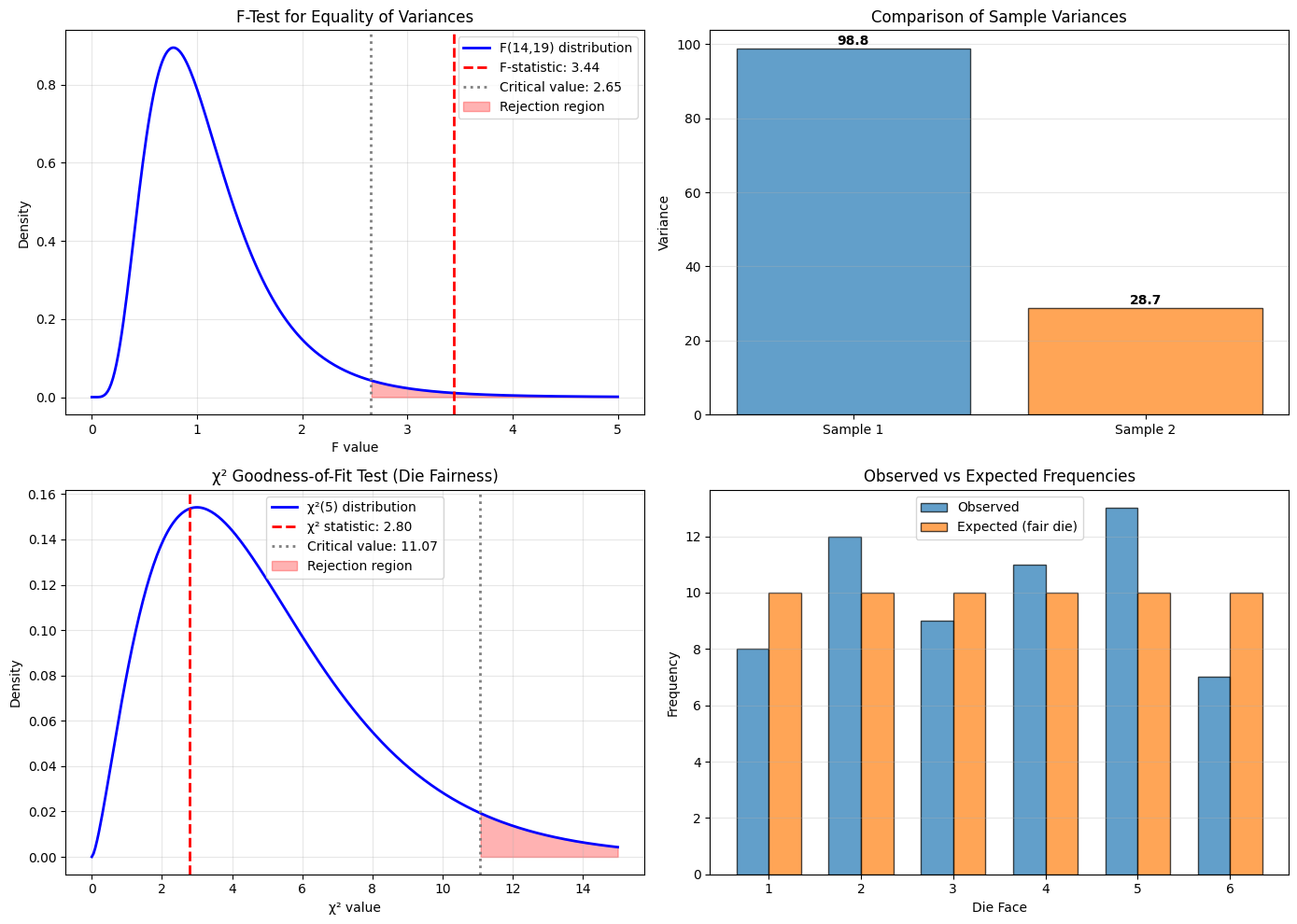
fig, axes = plt.subplots(2, 2, figsize=(14, 10))

# Plot 1: F-distribution
ax = axes[0, 0]
x_f = np.linspace(0, 5, 300)
y_f = stats.f.pdf(x_f, df1, df2)
ax.plot(x_f, y_f, 'b-', linewidth=2, label=f'F({df1},{df2}) distribution')
ax.axvline(F_stat, color='red', linestyle='--', linewidth=2, label=f'F-statistic: {F_stat:.2f}')
ax.axvline(F_critical, color='gray', linestyle=':', linewidth=2, label=f'Critical value: {F_critical:.2f}')
x_reject = x_f[x_f >= F_critical]
y_reject = stats.f.pdf(x_reject, df1, df2)
ax.fill_between(x_reject, y_reject, alpha=0.3, color='red', label='Rejection region')
ax.set_xlabel('F value')
ax.set_ylabel('Density')
ax.set_title('F-Test for Equality of Variances')
ax.legend()
ax.grid(True, alpha=0.3)

# Plot 2: Variance comparison
ax = axes[0, 1]
ax.bar(['Sample 1', 'Sample 2'], [var1, var2], color=['C0', 'C1'], alpha=0.7, edgecolor='black')
ax.set_ylabel('Variance')
ax.set_title('Comparison of Sample Variances')
ax.grid(True, alpha=0.3, axis='y')
for i, v in enumerate([var1, var2]):
    ax.text(i, v+1, f'{v:.1f}', ha='center', fontweight='bold')

# Plot 3: Chi-square distribution for die test
ax = axes[1, 0]
x_chi = np.linspace(0, 15, 300)
y_chi = stats.chi2.pdf(x_chi, df)
ax.plot(x_chi, y_chi, 'b-', linewidth=2, label=f'χ²({df}) distribution')
ax.axvline(chi2_stat, color='red', linestyle='--', linewidth=2, label=f'χ² statistic: {chi2_stat:.2f}')
ax.axvline(chi2_critical, color='gray', linestyle=':', linewidth=2, label=f'Critical value: {chi2_critical:.2f}')
x_reject_chi = x_chi[x_chi >= chi2_critical]
y_reject_chi = stats.chi2.pdf(x_reject_chi, df)
ax.fill_between(x_reject_chi, y_reject_chi, alpha=0.3, color='red', label='Rejection region')
ax.set_xlabel('χ² value')
ax.set_ylabel('Density')
ax.set_title('χ² Goodness-of-Fit Test (Die Fairness)')
ax.legend()
ax.grid(True, alpha=0.3)

# Plot 4: Die roll frequencies
ax = axes[1, 1]
faces = ['1', '2', '3', '4', '5', '6']
x_pos = np.arange(len(faces))
width = 0.35
ax.bar(x_pos - width/2, observed, width, label='Observed', alpha=0.7, edgecolor='black')
ax.bar(x_pos + width/2, expected, width, label='Expected (fair die)', alpha=0.7, edgecolor='black')
ax.set_xlabel('Die Face')
ax.set_ylabel('Frequency')
ax.set_title('Observed vs Expected Frequencies')
ax.set_xticks(x_pos)
ax.set_xticklabels(faces)
ax.legend()
ax.grid(True, alpha=0.3, axis='y')

plt.tight_layout()
plt.savefig('f_test_chi_square_tests.png', dpi=150, bbox_inches='tight')
plt.show()
============================================================
F-TEST EXAMPLE: Comparing Variances
============================================================
Sample 1: n=15, variance=98.83
Sample 2: n=20, variance=28.71
F-statistic: 3.443
Degrees of freedom: (14, 19)
Critical value (α=0.05): 2.647
P-value: 0.0135
Conclusion: Reject H₀ - Variances are significantly different

============================================================
χ² GOODNESS-OF-FIT TEST EXAMPLE: Testing a Die
============================================================
Total rolls: 60
Observed: [ 8 12  9 11 13  7]
Expected: [10. 10. 10. 10. 10. 10.]

χ² statistic: 2.800
Degrees of freedom: 5
Critical value (α=0.05): 11.070
P-value: 0.7308
Conclusion: Fail to reject H₀ - Die appears fair

Verification with scipy.stats.chisquare:
χ² = 2.800, p-value = 0.7308

============================================================
χ² TEST OF INDEPENDENCE EXAMPLE: Contingency Table
============================================================
Contingency table:
           Success  Failure
Treatment A:  50      150
Treatment B:  20      180

χ² statistic: 14.563
Degrees of freedom: 1
P-value: 0.0001
Conclusion: Reject H₀ - Treatment and outcome are dependent

Expected frequencies under independence:
[[ 35. 165.]
 [ 35. 165.]]
Key Takeaways#
F-Tests#
Compare two population variances
Test statistic is ratio of sample variances
Follows F-distribution with two degrees of freedom parameters
Sensitive to non-normality; use with caution
Common use: checking assumption for pooled t-test
χ² Goodness-of-Fit Tests#
Assess how well data fits a theoretical model
Test statistic compares observed and expected counts
Follows chi-square distribution
Requires expected counts \(\geq 5\) in each category
One-sided test (only reject for large χ²)
Can also test independence in contingency tables
General Testing Principles#
State hypotheses before collecting data
Check assumptions (normality, expected counts, etc.)
Report test statistic, degrees of freedom, and p-value
Interpret results in context of the problem