
5.4 Normal Approximation to Binomial#
When \(N\) is large, computing binomial probabilities exactly becomes computationally difficult. Fortunately, we can use the normal distribution as an approximation!
Why Do We Need This?#
The Problem#
Consider: What’s the probability of getting between 480 and 520 heads in 1000 coin flips?
Exact calculation: $\(P(480 \leq X \leq 520) = \sum_{k=480}^{520} \binom{1000}{k} \left(\frac{1}{2}\right)^{1000}\)$
This requires computing 41 binomial coefficients, each with huge factorials!
Better way: Use normal approximation.
5.4.1 When to Use the Approximation#
Rule of Thumb#
The normal approximation to \(\text{Binomial}(N, p)\) is good when:
Interpretation: Need at least 5 expected successes AND 5 expected failures.
The Approximation#
If \(X \sim \text{Binomial}(N, p)\) and \(N\) is large, then:
More precisely: $\(\frac{X - Np}{\sqrt{Np(1-p)}} \approx N(0, 1)\)$
import numpy as np
import matplotlib.pyplot as plt
from scipy import stats

# Compare binomial to normal approximation
N = 100
p = 0.3

# Binomial
k = np.arange(0, N+1)
binom_pmf = stats.binom.pmf(k, N, p)

# Normal approximation
mu = N * p
sigma = np.sqrt(N * p * (1-p))
x = np.linspace(0, N, 1000)
norm_pdf = stats.norm.pdf(x, mu, sigma)

plt.figure(figsize=(12, 6))
plt.bar(k, binom_pmf, alpha=0.7, edgecolor='black', label=f'Binomial({N}, {p})')
plt.plot(x, norm_pdf, 'r-', linewidth=2,
         label=f'Normal({mu:.1f}, {sigma**2:.1f})')
plt.axvline(mu, color='green', linestyle='--', linewidth=2, label=f'Mean = {mu}')
plt.xlabel('Number of Successes')
plt.ylabel('Probability / Density')
plt.title(f'Binomial vs Normal Approximation (N={N}, p={p})')
plt.legend()
plt.grid(True, alpha=0.3)
plt.show()

print(f"Binomial: Mean = {mu}, Variance = {N*p*(1-p):.2f}")
print(f"Normal approx: Mean = {mu}, Variance = {sigma**2:.2f}")
print(f"\nRule check: Np = {N*p:.1f} ≥ 5? {N*p >= 5}")
print(f"Rule check: N(1-p) = {N*(1-p):.1f} ≥ 5? {N*(1-p) >= 5}")
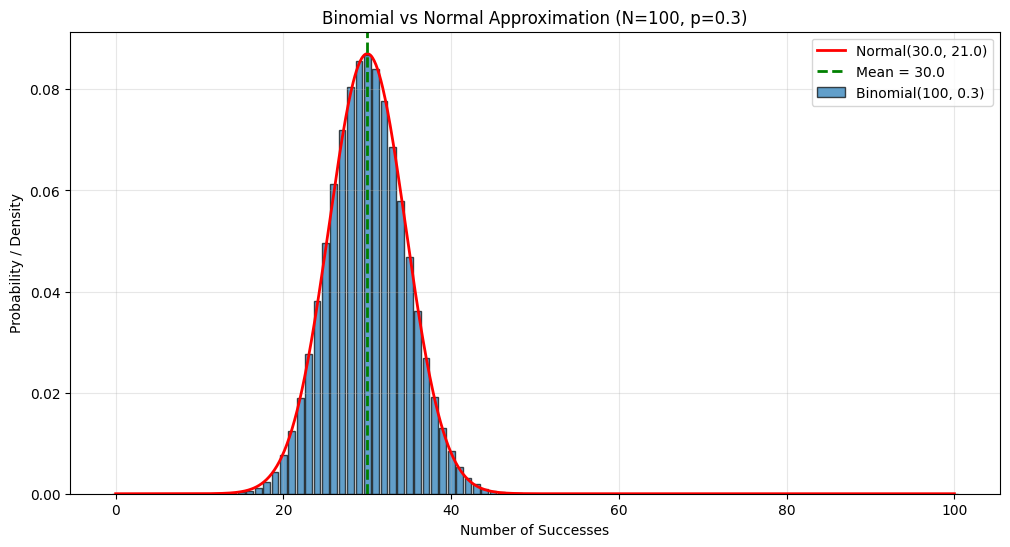
Binomial: Mean = 30.0, Variance = 21.00
Normal approx: Mean = 30.0, Variance = 21.00

Rule check: Np = 30.0 ≥ 5? True
Rule check: N(1-p) = 70.0 ≥ 5? True
5.4.2 The Continuity Correction#
The Issue#
Binomial is discrete, Normal is continuous. Need to be careful!
Problem: \(P(X = k)\) for discrete vs continuous
Binomial: \(P(X = k) > 0\)
Normal: \(P(X = k) = 0\) (single point has zero probability)
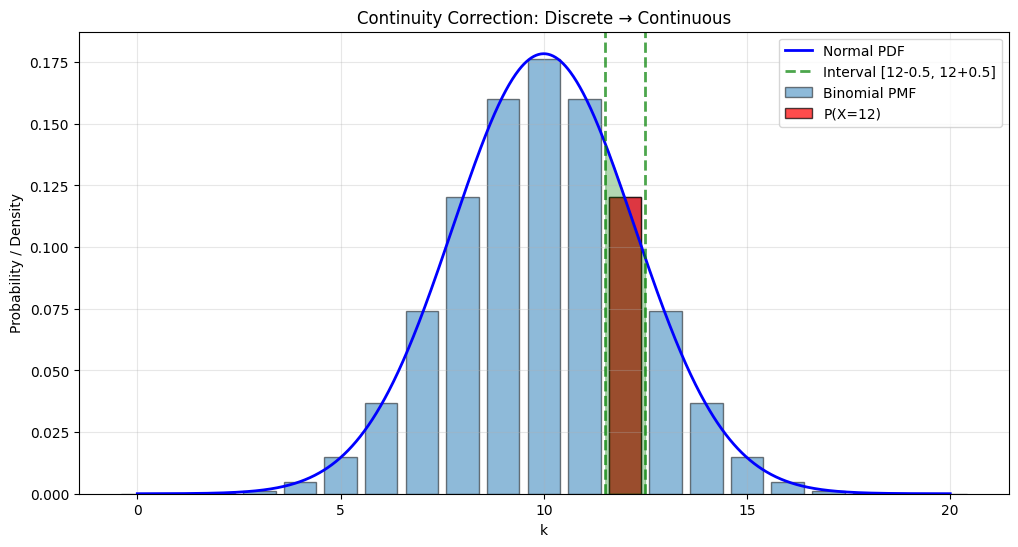
Solution: Continuity correction — treat discrete value \(k\) as the interval \([k - 0.5, k + 0.5]\).
How to Apply Continuity Correction#
Binomial Probability |
Without Correction |
With Correction |
|---|---|---|
\(P(X = k)\) |
\(P(k < Y < k)\) = 0 |
\(P(k - 0.5 < Y < k + 0.5)\) |
\(P(X \leq k)\) |
\(P(Y \leq k)\) |
\(P(Y \leq k + 0.5)\) |
\(P(X < k)\) |
\(P(Y < k)\) |
\(P(Y < k - 0.5)\) |
\(P(X \geq k)\) |
\(P(Y \geq k)\) |
\(P(Y \geq k - 0.5)\) |
\(P(X > k)\) |
\(P(Y > k)\) |
\(P(Y > k + 0.5)\) |
\(P(a \leq X \leq b)\) |
\(P(a \leq Y \leq b)\) |
\(P(a - 0.5 \leq Y \leq b + 0.5)\) |
where \(Y \sim N(Np, Np(1-p))\) is the normal approximation.
Visual Explanation#
# Demonstrate continuity correction
N, p = 20, 0.5
k_target = 12

mu = N * p
sigma = np.sqrt(N * p * (1-p))

# Exact binomial
exact_prob = stats.binom.pmf(k_target, N, p)

# Normal without correction
no_correction = 0  # P(Y = 12) = 0 for continuous

# Normal with correction
with_correction = stats.norm.cdf(k_target + 0.5, mu, sigma) - \
                  stats.norm.cdf(k_target - 0.5, mu, sigma)

print(f"P(X = {k_target}) for Binomial({N}, {p}):")
print(f"  Exact: {exact_prob:.4f}")
print(f"  Normal (no correction): {no_correction:.4f}")
print(f"  Normal (with correction): {with_correction:.4f}")
print(f"  Error with correction: {abs(exact_prob - with_correction):.4f}")

# Visualize
fig, ax = plt.subplots(figsize=(12, 6))

# Binomial bars
k = np.arange(0, N+1)
binom_pmf = stats.binom.pmf(k, N, p)
ax.bar(k, binom_pmf, alpha=0.5, edgecolor='black', label='Binomial PMF')

# Highlight k_target
ax.bar(k_target, stats.binom.pmf(k_target, N, p), color='red', alpha=0.7,
       edgecolor='black', label=f'P(X={k_target})')

# Normal approximation
x = np.linspace(0, N, 1000)
norm_pdf = stats.norm.pdf(x, mu, sigma)
ax.plot(x, norm_pdf, 'b-', linewidth=2, label='Normal PDF')

# Show continuity correction interval
ax.axvline(k_target - 0.5, color='green', linestyle='--', linewidth=2, alpha=0.7)
ax.axvline(k_target + 0.5, color='green', linestyle='--', linewidth=2, alpha=0.7,
          label=f'Interval [{k_target}-0.5, {k_target}+0.5]')
x_fill = x[(x >= k_target - 0.5) & (x <= k_target + 0.5)]
y_fill = stats.norm.pdf(x_fill, mu, sigma)
ax.fill_between(x_fill, 0, y_fill, alpha=0.3, color='green')

ax.set_xlabel('k')
ax.set_ylabel('Probability / Density')
ax.set_title('Continuity Correction: Discrete → Continuous')
ax.legend()
ax.grid(True, alpha=0.3)
plt.show()
P(X = 12) for Binomial(20, 0.5):
  Exact: 0.1201
  Normal (no correction): 0.0000
  Normal (with correction): 0.1194
  Error with correction: 0.0007
5.4.3 Worked Examples#
Example 1: Coin Flips#
Question: Flip a fair coin 1000 times. What’s the probability of getting between 480 and 520 heads?
Solution:
N = 1000
p = 0.5
a, b = 480, 520

# Parameters for normal approximation
mu = N * p
sigma = np.sqrt(N * p * (1-p))

print(f"Binomial({N}, {p})")
print(f"Normal approximation: N({mu}, {sigma**2})")
print(f"\nCheck rule: Np = {N*p}, N(1-p) = {N*(1-p)}")

# With continuity correction
prob_approx = stats.norm.cdf(b + 0.5, mu, sigma) - \
              stats.norm.cdf(a - 0.5, mu, sigma)

print(f"\nP({a} ≤ X ≤ {b}) ≈ {prob_approx:.4f}")

# Exact (for comparison, using sum)
exact = sum(stats.binom.pmf(k, N, p) for k in range(a, b+1))
print(f"Exact binomial: {exact:.4f}")
print(f"Error: {abs(exact - prob_approx):.6f}")
Binomial(1000, 0.5)
Normal approximation: N(500.0, 250.0)

Check rule: Np = 500.0, N(1-p) = 500.0

P(480 ≤ X ≤ 520) ≈ 0.8052
Exact binomial: 0.8052
Error: 0.000025
Example 2: Quality Control#
Question: A factory produces items with 2% defect rate. In a batch of 500, what’s the probability of: a) Exactly 10 defects? b) At most 15 defects? c) More than 5 defects?
Solution:
N = 500
p = 0.02

# Check rule
print(f"Check: Np = {N*p}, N(1-p) = {N*(1-p)}")
print("Both ≥ 5? ", N*p >= 5 and N*(1-p) >= 5)

mu = N * p
sigma = np.sqrt(N * p * (1-p))

print(f"\nNormal approximation: N({mu}, {sigma**2:.2f})")

# a) Exactly 10 defects
k = 10
prob_exact_approx = stats.norm.cdf(k + 0.5, mu, sigma) - \
                    stats.norm.cdf(k - 0.5, mu, sigma)
prob_exact_true = stats.binom.pmf(k, N, p)

print(f"\na) P(X = {k}):")
print(f"   Approximation: {prob_exact_approx:.4f}")
print(f"   Exact: {prob_exact_true:.4f}")

# b) At most 15 defects
k = 15
prob_atmost_approx = stats.norm.cdf(k + 0.5, mu, sigma)
prob_atmost_true = stats.binom.cdf(k, N, p)

print(f"\nb) P(X ≤ {k}):")
print(f"   Approximation: {prob_atmost_approx:.4f}")
print(f"   Exact: {prob_atmost_true:.4f}")

# c) More than 5 defects
k = 5
prob_more_approx = 1 - stats.norm.cdf(k + 0.5, mu, sigma)
prob_more_true = 1 - stats.binom.cdf(k, N, p)

print(f"\nc) P(X > {k}):")
print(f"   Approximation: {prob_more_approx:.4f}")
print(f"   Exact: {prob_more_true:.4f}")
Check: Np = 10.0, N(1-p) = 490.0
Both ≥ 5?  True

Normal approximation: N(10.0, 9.80)

a) P(X = 10):
   Approximation: 0.1269
   Exact: 0.1264

b) P(X ≤ 15):
   Approximation: 0.9605
   Exact: 0.9530

c) P(X > 5):
   Approximation: 0.9247
   Exact: 0.9348
Example 3: When Approximation Fails#
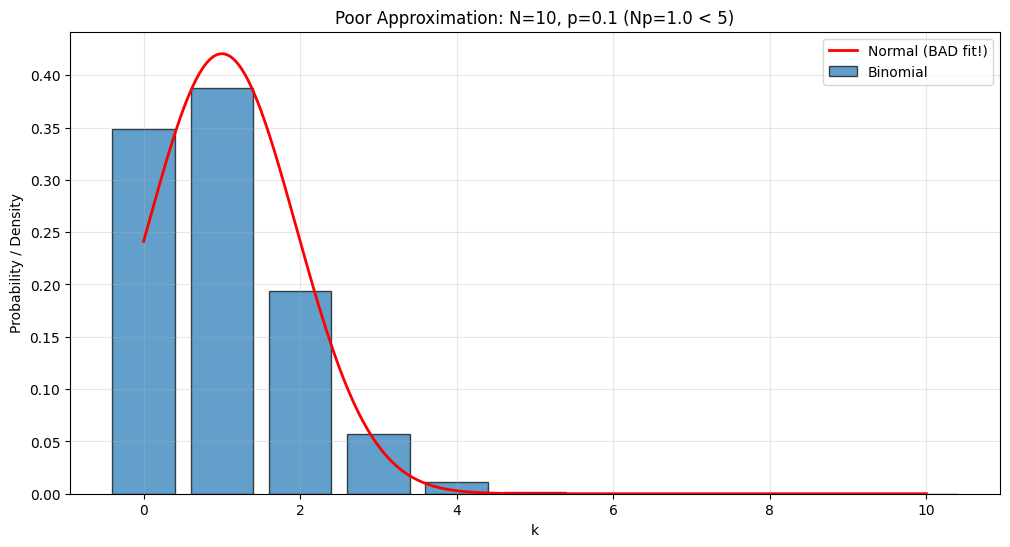
Question: Does the approximation work for \(N=10, p=0.1\)?
N = 10
p = 0.1

print(f"Check: Np = {N*p}, N(1-p) = {N*(1-p)}")
print("Both ≥ 5? ", N*p >= 5 and N*(1-p) >= 5)
print("\n→ NO! Approximation will be poor.\n")

mu = N * p
sigma = np.sqrt(N * p * (1-p))

# Compare for k=2
k = 2
exact = stats.binom.pmf(k, N, p)
approx = stats.norm.cdf(k + 0.5, mu, sigma) - stats.norm.cdf(k - 0.5, mu, sigma)

print(f"P(X = {k}):")
print(f"  Exact: {exact:.4f}")
print(f"  Approximation: {approx:.4f}")
print(f"  Relative error: {abs(exact - approx)/exact * 100:.1f}%")

# Visualize
fig, ax = plt.subplots(figsize=(12, 6))

k_vals = np.arange(0, N+1)
binom_pmf = stats.binom.pmf(k_vals, N, p)
ax.bar(k_vals, binom_pmf, alpha=0.7, edgecolor='black', label='Binomial')

x = np.linspace(0, N, 1000)
norm_pdf = stats.norm.pdf(x, mu, sigma)
ax.plot(x, norm_pdf, 'r-', linewidth=2, label='Normal (BAD fit!)')

ax.set_xlabel('k')
ax.set_ylabel('Probability / Density')
ax.set_title(f'Poor Approximation: N={N}, p={p} (Np={N*p} < 5)')
ax.legend()
ax.grid(True, alpha=0.3)
plt.show()
Check: Np = 1.0, N(1-p) = 9.0
Both ≥ 5?  False

→ NO! Approximation will be poor.

P(X = 2):
  Exact: 0.1937
  Approximation: 0.2422
  Relative error: 25.0%
5.4.4 Why Does This Work?#
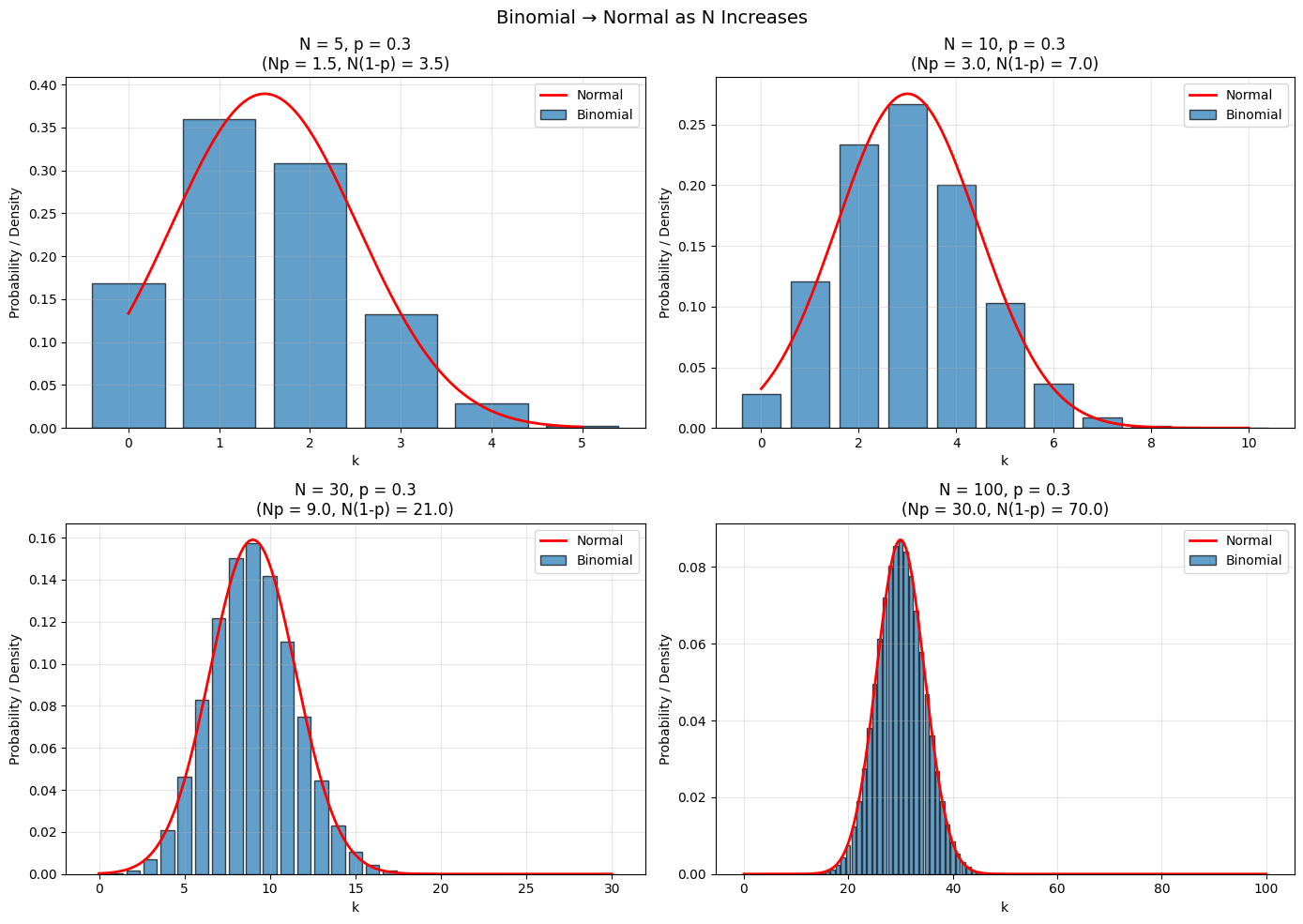
The Central Limit Theorem explains why!
Key insight: A Binomial\((N, p)\) random variable is the sum of \(N\) independent Bernoulli\((p)\) random variables:
where each \(Y_i \sim \text{Bernoulli}(p)\).
By the CLT, as \(N\) gets large, the distribution of this sum approaches normal!
# Visualize convergence to normal
from scipy.stats import binom

p = 0.3
N_values = [5, 10, 30, 100]

fig, axes = plt.subplots(2, 2, figsize=(14, 10))
axes = axes.flatten()

for idx, N in enumerate(N_values):
    k = np.arange(0, N+1)
    binom_pmf = binom.pmf(k, N, p)

    mu = N * p
    sigma = np.sqrt(N * p * (1-p))
    x = np.linspace(0, N, 1000)
    norm_pdf = stats.norm.pdf(x, mu, sigma)

    axes[idx].bar(k, binom_pmf, alpha=0.7, edgecolor='black', label='Binomial')
    axes[idx].plot(x, norm_pdf, 'r-', linewidth=2, label='Normal')
    axes[idx].set_xlabel('k')
    axes[idx].set_ylabel('Probability / Density')
    axes[idx].set_title(f'N = {N}, p = {p}\n(Np = {N*p:.1f}, N(1-p) = {N*(1-p):.1f})')
    axes[idx].legend()
    axes[idx].grid(True, alpha=0.3)

plt.suptitle('Binomial → Normal as N Increases', fontsize=14)
plt.tight_layout()
plt.show()
Summary#
Normal Approximation to Binomial
When: \(X \sim \text{Binomial}(N, p)\) with \(Np \geq 5\) AND \(N(1-p) \geq 5\)
Approximation: $\(X \approx N(Np, Np(1-p))\)$
Continuity Correction:
\(P(X = k) \approx P(k - 0.5 < Y < k + 0.5)\)
\(P(X \leq k) \approx P(Y \leq k + 0.5)\)
\(P(X \geq k) \approx P(Y \geq k - 0.5)\)
where \(Y \sim N(Np, Np(1-p))\)
Why: Central Limit Theorem!
Practice Problems#
A coin is flipped 400 times. Use normal approximation to find:
\(P(190 \leq X \leq 210)\)
\(P(X \geq 220)\)
The value \(k\) such that \(P(X \geq k) = 0.05\)
A multiple choice test has 100 questions, each with 4 choices. If you guess randomly:
What’s the probability of getting exactly 25 correct?
What’s the probability of passing (60% or more)?
A website has 1% conversion rate. With 10,000 visitors:
What’s the probability of at least 120 conversions?
Between 80 and 110 conversions?
For \(\text{Binomial}(20, 0.1)\), compare exact and approximate probabilities for \(P(X = 3)\). Is the approximation good?
Derive the continuity correction formula starting from the histogram interpretation of discrete distributions.
Chapter 5 Conclusion#
You now know:
Discrete distributions: Uniform, Bernoulli, Geometric, Binomial, Multinomial, Poisson
Continuous distributions: Uniform, Beta, Gamma, Exponential
The Normal distribution: Most important distribution in statistics
Normal approximation: How to use CLT for practical calculations
These distributions form the toolkit for modeling real-world phenomena and form the foundation for statistical inference!
→ Return to Chapter 5 Overview
→ Continue to Part III: Inference