
Overview
The 8-puzzle is a classic AI problem consisting of a 3×3 grid with tiles numbered 1–8 and one blank space.
The goal is to slide tiles until the board matches the goal configuration.
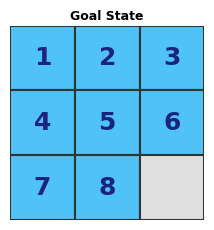
Initial State       Goal State
┌───┬───┬───┐      ┌───┬───┬───┐
│ 1 │ 2 │ 5 │      │ 1 │ 2 │ 3 │
├───┼───┼───┤  →   ├───┼───┼───┤
│ 3 │ 4 │   │      │ 4 │ 5 │ 6 │
├───┼───┼───┤      ├───┼───┼───┤
│ 6 │ 7 │ 8 │      │ 7 │ 8 │   │
└───┴───┴───┘      └───┴───┴───┘
Algorithms Covered
| Algorithm | Strategy | Complete | Optimal | Space |
|---|---|---|---|---|
| BFS | Level-by-level (FIFO) | ✅ Yes | ✅ Yes | Exponential |
| DFS | Depth-first (LIFO) | ⚠️ With limit | ❌ No | Linear |
| UCS | Lowest cost first | ✅ Yes | ✅ Yes | Exponential |
# Install required packages (run once)
import subprocess, sys
subprocess.run([sys.executable, "-m", "pip", "install", "ipywidgets", "matplotlib", "--quiet"], check=False)
print("Dependencies ready.")
Dependencies ready.
import heapq
import time
import sys
from collections import deque
import matplotlib.pyplot as plt
import matplotlib.patches as mpatches
import matplotlib.colors as mcolors
import ipywidgets as widgets
from IPython.display import display, clear_output
import warnings
warnings.filterwarnings("ignore")

print("All imports successful ✓")
All imports successful ✓
Part 1 — State Representation & Puzzle Core
A state is represented as a tuple of 9 integers, read row-by-row (left-to-right, top-to-bottom).0 represents the blank tile.
State tuple:  (1, 2, 5, 3, 4, 0, 6, 7, 8)
Board layout:
  1  2  5
  3  4  _
  6  7  8
Moves are defined by how the blank (index of 0) can swap with adjacent tiles:
| Move | Blank shifts by | Valid when |
|---|---|---|
| Up | −3 | row > 0 |
| Down | +3 | row < 2 |
| Left | −1 | col > 0 |
| Right | +1 | col < 2 |
# ─── Puzzle Core ──────────────────────────────────────────────────────────────

GOAL_STATE = (1, 2, 3, 4, 5, 6, 7, 8, 0)

MOVES = {
    "Up":    -3,
    "Down":  +3,
    "Left":  -1,
    "Right": +1,
}

def is_goal(state):
    """Return True if state matches the goal."""
    return state == GOAL_STATE

def get_blank(state):
    """Return the (row, col) position of the blank tile."""
    idx = state.index(0)
    return idx // 3, idx % 3

def get_neighbors(state):
    """
    Generate all valid successor states together with the move name and step cost.
    Returns a list of (move_name, new_state, cost) tuples.
    """
    row, col = get_blank(state)
    blank = row * 3 + col
    neighbors = []

    moves_valid = []
    if row > 0: moves_valid.append(("Up",    MOVES["Up"]))
    if row < 2: moves_valid.append(("Down",  MOVES["Down"]))
    if col > 0: moves_valid.append(("Left",  MOVES["Left"]))
    if col < 2: moves_valid.append(("Right", MOVES["Right"]))

    for move_name, delta in moves_valid:
        lst = list(state)
        lst[blank], lst[blank + delta] = lst[blank + delta], lst[blank]
        neighbors.append((move_name, tuple(lst), 1))   # uniform cost = 1

    return neighbors

def print_state(state, label=""):
    """Pretty-print a puzzle state."""
    if label:
        print(f"  {label}")
    for i in range(0, 9, 3):
        row = ""
        for v in state[i:i+3]:
            row += f"  {v if v != 0 else '_'}"
        print(row)
    print()

def reconstruct_path(came_from, start, goal):
    """Reconstruct the sequence of (move, state) from start to goal."""
    path = []
    state = goal
    while state != start:
        move, prev = came_from[state]
        path.append((move, state))
        state = prev
    path.reverse()
    return path

# ── Quick sanity check ────────────────────────────────────────────────────────
sample = (1, 2, 5, 3, 4, 0, 6, 7, 8)
print_state(sample, label="Sample initial state")
print("Blank at:", get_blank(sample))
print("Neighbors:")
for mv, ns, c in get_neighbors(sample):
    print(f"  Move {mv:5s} → {ns}")
  Sample initial state
  1  2  5
  3  4  _
  6  7  8

Blank at: (1, 2)
Neighbors:
  Move Up    → (1, 2, 0, 3, 4, 5, 6, 7, 8)
  Move Down  → (1, 2, 5, 3, 4, 8, 6, 7, 0)
  Move Left  → (1, 2, 5, 3, 0, 4, 6, 7, 8)
# ─── Visualization Helper ─────────────────────────────────────────────────────

def draw_state(ax, state, title="", highlight=None):
    """Draw a single puzzle state as a grid on a matplotlib Axes."""
    ax.set_xlim(0, 3)
    ax.set_ylim(0, 3)
    ax.set_aspect("equal")
    ax.axis("off")
    if title:
        ax.set_title(title, fontsize=9, pad=4, fontweight="bold")

    for idx, val in enumerate(state):
        r, c = idx // 3, idx % 3
        y = 2 - r   # flip so row 0 is at top

        if val == 0:
            color = "#e0e0e0"
            txt = ""
        elif highlight and idx in highlight:
            color = "#ffd54f"
            txt = str(val)
        else:
            color = "#4fc3f7"
            txt = str(val)

        rect = plt.Rectangle([c, y], 1, 1, linewidth=1.5,
                              edgecolor="#333", facecolor=color)
        ax.add_patch(rect)
        if txt:
            ax.text(c + 0.5, y + 0.5, txt,
                    ha="center", va="center",
                    fontsize=18, fontweight="bold", color="#1a237e")

def draw_path(path, start, title="Solution Path", max_show=12):
    """Visualise the solution path as a row of puzzle states."""
    states = [start] + [s for _, s in path]
    moves  = ["Start"] + [m for m, _ in path]

    if len(states) > max_show:
        states = states[:max_show]
        moves  = moves[:max_show]
        truncated = True
    else:
        truncated = False

    n = len(states)
    fig, axes = plt.subplots(1, n, figsize=(n * 2.0, 2.8))
    if n == 1:
        axes = [axes]
    fig.suptitle(title, fontsize=11, fontweight="bold", y=1.02)

    for i, (ax, state, move) in enumerate(zip(axes, states, moves)):
        draw_state(ax, state, title=f"[{i}] {move}")
        if i > 0:
            ax.annotate("", xy=(-0.15, 0.5), xycoords="axes fraction",
                        xytext=(0.0, 0.5),
                        arrowprops=dict(arrowstyle="<-", color="gray", lw=1.5))

    if truncated:
        fig.text(0.99, -0.05,
                 f"(showing first {max_show} of {len(path)+1} steps)",
                 ha="right", fontsize=8, color="gray")

    plt.tight_layout()
    plt.show()

# ── Demo using sample state ───────────────────────────────────────────────────
fig, ax = plt.subplots(figsize=(2.4, 2.4))
draw_state(ax, GOAL_STATE, title="Goal State")
plt.tight_layout()
plt.show()
Part 2 — Breadth-First Search (BFS)
How it works
BFS explores states level by level using a FIFO queue.
All states at depth are examined before any state at depth .
Queue: [start]
while queue not empty:
    node = queue.popleft()        # dequeue from front
    if goal(node): return path
    for each neighbor of node:
        if not visited:
            visited.add(neighbor)
            queue.append(neighbor)
Properties:
Complete — guaranteed to find a solution if one exists
Optimal — finds the shallowest (shortest) solution
Time/Space — where = branching factor, = solution depth
# ─── BFS Implementation ───────────────────────────────────────────────────────

def bfs(start):
    """
    Breadth-First Search for the 8-puzzle.

    Parameters
    ----------
    start : tuple  – initial puzzle state (9-element tuple, 0 = blank)

    Returns
    -------
    dict with keys:
        path          – list of (move, state) from start to goal
        nodes_expanded – number of states dequeued & expanded
        max_frontier   – peak frontier (queue) size
        time_s         – wall-clock seconds
        found          – bool, whether a solution was found
    """
    if is_goal(start):
        return dict(path=[], nodes_expanded=0, max_frontier=1, time_s=0.0, found=True)

    frontier   = deque([start])         # FIFO queue
    visited    = {start}                # closed set
    came_from  = {start: None}         # state → (move, parent_state)

    nodes_expanded = 0
    max_frontier   = 1
    t0             = time.perf_counter()

    while frontier:
        max_frontier = max(max_frontier, len(frontier))
        state = frontier.popleft()      # ← FIFO
        nodes_expanded += 1

        for move, neighbor, _ in get_neighbors(state):
            if neighbor not in visited:
                visited.add(neighbor)
                came_from[neighbor] = (move, state)

                if is_goal(neighbor):
                    t1 = time.perf_counter()
                    path = reconstruct_path(came_from, start, neighbor)
                    return dict(path=path, nodes_expanded=nodes_expanded,
                                max_frontier=max_frontier,
                                time_s=round(t1 - t0, 4), found=True)

                frontier.append(neighbor)

    t1 = time.perf_counter()
    return dict(path=[], nodes_expanded=nodes_expanded,
                max_frontier=max_frontier,
                time_s=round(t1 - t0, 4), found=False)


# ── Run BFS on sample puzzle ──────────────────────────────────────────────────
# (1,2,5,3,4,0,6,7,8) has 2 inversions → solvable
START = (1, 2, 5, 3, 4, 0, 6, 7, 8)

print("=== BFS ===")
print_state(START, label="Initial State")

result_bfs = bfs(START)

if result_bfs["found"]:
    print(f"  Solution depth    : {len(result_bfs['path'])} moves")
    print(f"  Nodes expanded    : {result_bfs['nodes_expanded']:,}")
    print(f"  Max frontier size : {result_bfs['max_frontier']:,}")
    print(f"  Time              : {result_bfs['time_s']} s\n")
    print("  Move sequence:", " → ".join(m for m, _ in result_bfs["path"]))
else:
    print("  No solution found.")
=== BFS ===
  Initial State
  1  2  5
  3  4  _
  6  7  8

  Solution depth    : 21 moves
  Nodes expanded    : 49,595
  Max frontier size : 18,252
  Time              : 0.2126 s

  Move sequence: Down → Left → Up → Left → Down → Right → Right → Up → Left → Left → Up → Right → Right → Down → Left → Up → Left → Down → Down → Right → Right
# ─── Visualise BFS path ───────────────────────────────────────────────────────
if result_bfs["found"]:
    draw_path(result_bfs["path"], START, title=f"BFS Solution — {len(result_bfs['path'])} moves")

Part 3 — Depth-First Search (DFS)
How it works
DFS explores states by diving as deep as possible before backtracking.
It uses a LIFO stack and a depth limit to avoid infinite loops.
Stack: [start]
while stack not empty:
    node, depth = stack.pop()         # pop from top
    if goal(node): return path
    if depth >= limit: continue       # depth cut-off
    for each neighbor of node (reversed):
        if not visited:
            stack.append((neighbor, depth+1))
Properties:
Complete — only with a depth limit and visited set
Optimal — ❌ may find a longer path first
Time — where = max depth
Space — — much more memory-efficient than BFS
# ─── DFS Implementation ───────────────────────────────────────────────────────

def dfs(start, depth_limit=150):
    """
    Depth-First Search (with depth limit & visited set) for the 8-puzzle.

    Parameters
    ----------
    start       : tuple – initial state
    depth_limit : int   – maximum search depth (prevents infinite loops)

    Returns
    -------
    Same dict structure as bfs().
    """
    if is_goal(start):
        return dict(path=[], nodes_expanded=0, max_frontier=1, time_s=0.0, found=True)

    # Stack entries: (state, depth, came_from snapshot for this branch)
    # We store came_from globally and overwrite — DFS is not optimal anyway.
    stack      = [(start, 0)]           # LIFO stack
    visited    = {start}
    came_from  = {start: None}

    nodes_expanded = 0
    max_frontier   = 1
    t0             = time.perf_counter()

    while stack:
        max_frontier = max(max_frontier, len(stack))
        state, depth = stack.pop()      # ← LIFO
        nodes_expanded += 1

        if is_goal(state):
            t1 = time.perf_counter()
            path = reconstruct_path(came_from, start, state)
            return dict(path=path, nodes_expanded=nodes_expanded,
                        max_frontier=max_frontier,
                        time_s=round(t1 - t0, 4), found=True)

        if depth >= depth_limit:
            continue                    # depth cut-off

        # Reverse so that "Up" is tried first when popped
        for move, neighbor, _ in reversed(get_neighbors(state)):
            if neighbor not in visited:
                visited.add(neighbor)
                came_from[neighbor] = (move, state)
                stack.append((neighbor, depth + 1))

    t1 = time.perf_counter()
    return dict(path=[], nodes_expanded=nodes_expanded,
                max_frontier=max_frontier,
                time_s=round(t1 - t0, 4), found=False)


# ── Run DFS on sample puzzle ──────────────────────────────────────────────────
print_state(START, label="Initial State")

result_dfs = dfs(START, depth_limit=20000)

if result_dfs["found"]:
    print(f"  Solution depth    : {len(result_dfs['path'])} moves")
    print(f"  Nodes expanded    : {result_dfs['nodes_expanded']:,}")
    print(f"  Max frontier size : {result_dfs['max_frontier']:,}")
    print(f"  Time              : {result_dfs['time_s']} s\n")
    print("  Move sequence:", " → ".join(m for m, _ in result_dfs["path"]))
else:
    print("  No solution found (depth limit reached or unsolvable).")
# ─── Visualise DFS path ───────────────────────────────────────────────────────
if result_dfs["found"]:
    draw_path(result_dfs["path"], START,
              title=f"DFS Solution — {len(result_dfs['path'])} moves  (depth limit 50)")
else:
    print("DFS did not find a solution within the depth limit.")

Part 4 — Uniform Cost Search (UCS)
How it works
UCS always expands the node with the lowest cumulative path cost .
It uses a min-heap priority queue ordered by .
PQ: [(cost=0, start)]
while PQ not empty:
    cost, node = heappop(PQ)          # cheapest node
    if goal(node): return path
    for each (neighbor, step_cost):
        new_cost = cost + step_cost
        if neighbor not seen or cheaper:
            heappush(PQ, (new_cost, neighbor))
Since every step has cost = 1 in the standard 8-puzzle, UCS behaves identically to BFS.
The implementation below uses general step costs so you can experiment with non-uniform costs.
Properties:
Complete — yes (positive step costs)
Optimal — yes, finds minimum-cost solution
Time/Space — where = optimal cost
# ─── UCS Implementation ───────────────────────────────────────────────────────

def ucs(start, cost_fn=None):
    """
    Uniform Cost Search for the 8-puzzle.

    Parameters
    ----------
    start   : tuple – initial state
    cost_fn : callable(move, state) → int, optional
              Custom step-cost function.  Defaults to 1 for every move.

    Returns
    -------
    Same dict structure as bfs().
    """
    if cost_fn is None:
        cost_fn = lambda move, state: 1   # default: uniform cost

    if is_goal(start):
        return dict(path=[], nodes_expanded=0, max_frontier=1, time_s=0.0, found=True)

    # Priority queue entries: (cumulative_cost, tie_breaker, state)
    counter    = 0
    frontier   = [(0, counter, start)]
    heapq.heapify(frontier)

    visited    = {}          # state → best cost seen
    came_from  = {start: None}

    nodes_expanded = 0
    max_frontier   = 1
    t0             = time.perf_counter()

    while frontier:
        max_frontier = max(max_frontier, len(frontier))
        g, _, state  = heapq.heappop(frontier)

        # Skip if we already found a cheaper path to this state
        if state in visited and visited[state] < g:
            continue
        visited[state] = g
        nodes_expanded += 1

        if is_goal(state):
            t1 = time.perf_counter()
            path = reconstruct_path(came_from, start, state)
            return dict(path=path, nodes_expanded=nodes_expanded,
                        max_frontier=max_frontier,
                        time_s=round(t1 - t0, 4), found=True,
                        total_cost=g)

        for move, neighbor, _ in get_neighbors(state):
            step  = cost_fn(move, state)
            new_g = g + step
            if neighbor not in visited or visited[neighbor] > new_g:
                came_from[neighbor] = (move, state)
                counter += 1
                heapq.heappush(frontier, (new_g, counter, neighbor))

    t1 = time.perf_counter()
    return dict(path=[], nodes_expanded=nodes_expanded,
                max_frontier=max_frontier,
                time_s=round(t1 - t0, 4), found=False, total_cost=None)


# ── Run UCS on sample puzzle (uniform cost = 1) ───────────────────────────────
print("=== UCS (uniform step cost = 1) ===")
print_state(START, label="Initial State")

result_ucs = ucs(START)

if result_ucs["found"]:
    print(f"  Solution depth    : {len(result_ucs['path'])} moves")
    print(f"  Total path cost   : {result_ucs.get('total_cost', 'N/A')}")
    print(f"  Nodes expanded    : {result_ucs['nodes_expanded']:,}")
    print(f"  Max frontier size : {result_ucs['max_frontier']:,}")
    print(f"  Time              : {result_ucs['time_s']} s\n")
    print("  Move sequence:", " → ".join(m for m, _ in result_ucs["path"]))
else:
    print("  No solution found.")
=== UCS (uniform step cost = 1) ===
  Initial State
  1  2  5
  3  4  _
  6  7  8

  Solution depth    : 21 moves
  Total path cost   : 21
  Nodes expanded    : 105,848
  Max frontier size : 44,729
  Time              : 0.6586 s

  Move sequence: Down → Left → Up → Left → Down → Right → Right → Up → Left → Left → Up → Right → Right → Down → Left → Up → Left → Down → Down → Right → Right
# ─── Visualise UCS path ───────────────────────────────────────────────────────
if result_ucs["found"]:
    draw_path(result_ucs["path"], START,
              title=f"UCS Solution — {len(result_ucs['path'])} moves  (total cost {result_ucs.get('total_cost','-')})")
else:
    print("UCS did not find a solution.")

Part 5 — Interactive Comparison
Use the widget below to:
Enter any starting configuration (a permutation of 0–8, where 0 = blank)
Choose a DFS depth limit
Run all three algorithms and compare results side-by-side
⚠️ Not every tile arrangement is solvable. The widget will warn you if your puzzle is unsolvable.
# ─── Solvability checker ──────────────────────────────────────────────────────

def count_inversions(state):
    """Count the number of inversions (ignoring the blank tile)."""
    tiles = [v for v in state if v != 0]
    inv = 0
    for i in range(len(tiles)):
        for j in range(i + 1, len(tiles)):
            if tiles[i] > tiles[j]:
                inv += 1
    return inv

def is_solvable(state):
    """An 8-puzzle is solvable iff the number of inversions is even."""
    return count_inversions(state) % 2 == 0

# ─── Bar chart comparison ─────────────────────────────────────────────────────

def plot_comparison(results, start):
    """Draw a 2×2 grid comparing the three algorithms."""
    algos   = list(results.keys())
    colors  = ["#4fc3f7", "#81c784", "#ffb74d"]

    metrics = {
        "Path Length (moves)":    [len(r["path"]) if r["found"] else 0 for r in results.values()],
        "Nodes Expanded":         [r["nodes_expanded"] for r in results.values()],
        "Max Frontier Size":      [r["max_frontier"] for r in results.values()],
        "Time (s)":               [r["time_s"] for r in results.values()],
    }

    fig, axes = plt.subplots(1, 4, figsize=(14, 3.8))
    fig.suptitle("Algorithm Comparison", fontsize=13, fontweight="bold")

    for ax, (metric, vals) in zip(axes, metrics.items()):
        bars = ax.bar(algos, vals, color=colors, edgecolor="#333", linewidth=0.8)
        ax.set_title(metric, fontsize=9, fontweight="bold")
        ax.set_xticks(range(len(algos)))
        ax.set_xticklabels(algos, fontsize=9)
        ax.yaxis.set_tick_params(labelsize=8)
        for bar, val in zip(bars, vals):
            ax.text(bar.get_x() + bar.get_width() / 2,
                    bar.get_height() * 1.02,
                    f"{val:,}" if isinstance(val, int) else f"{val:.4f}",
                    ha="center", va="bottom", fontsize=8, fontweight="bold")
        ax.set_ylim(0, max(vals) * 1.25 + 1)
        ax.spines[["top", "right"]].set_visible(False)

    plt.tight_layout()
    plt.show()

# ─── Summary table ────────────────────────────────────────────────────────────

def print_summary_table(results):
    header = f"{'Algorithm':<10} {'Found':>6} {'Path':>6} {'Cost':>6} {'Nodes':>9} {'FrontierMax':>12} {'Time(s)':>9}"
    print(header)
    print("-" * len(header))
    for name, r in results.items():
        found  = "✓" if r["found"] else "✗"
        depth  = len(r["path"]) if r["found"] else "-"
        cost   = r.get("total_cost", depth) if r["found"] else "-"
        nodes  = r["nodes_expanded"]
        front  = r["max_frontier"]
        t      = r["time_s"]
        print(f"{name:<10} {found:>6} {str(depth):>6} {str(cost):>6} {nodes:>9,} {front:>12,} {t:>9.4f}")
# ─── Interactive Widget ───────────────────────────────────────────────────────

style  = {"description_width": "140px"}
layout = widgets.Layout(width="320px")

# Preset puzzles
PRESETS = {
    "Easy   (2 8 3 | 1 6 4 | 7 _ 5)": "2 8 3 1 6 4 7 0 5",
    "Medium (1 2 5 | 3 4 _ | 6 7 8)": "1 2 5 3 4 0 6 7 8",
    "Hard   (8 6 7 | 2 5 4 | 3 _ 1)": "8 6 7 2 5 4 3 0 1",
    "Custom (edit below)":             "",
}

w_preset = widgets.Dropdown(
    options=list(PRESETS.keys()),
    value=list(PRESETS.keys())[0],
    description="Preset puzzle:",
    style=style, layout=layout,
)
w_state = widgets.Text(
    value=PRESETS[w_preset.value],
    placeholder="e.g. 2 8 3 1 6 4 7 0 5",
    description="State (0=blank):",
    style=style, layout=layout,
)
w_depth = widgets.IntSlider(
    value=50, min=5, max=100, step=5,
    description="DFS depth limit:",
    style=style, layout=layout,
    continuous_update=False,
)
w_show_path = widgets.Checkbox(
    value=True,
    description="Show solution paths",
    style=style,
)
w_btn = widgets.Button(
    description="Run All Algorithms",
    button_style="primary",
    icon="play",
    layout=widgets.Layout(width="200px", height="36px"),
)
w_out = widgets.Output()

def on_preset_change(change):
    val = PRESETS.get(change["new"], "")
    if val:
        w_state.value = val

w_preset.observe(on_preset_change, names="value")

def on_run(b):
    with w_out:
        clear_output(wait=True)

        # Parse state
        try:
            vals = list(map(int, w_state.value.strip().split()))
        except ValueError:
            print("❌ Invalid input — enter 9 space-separated integers (0–8).")
            return

        if sorted(vals) != list(range(9)):
            print("❌ State must be a permutation of 0–8.")
            return

        start = tuple(vals)

        if not is_solvable(start):
            print("⚠️  This puzzle is UNSOLVABLE (odd number of inversions).")
            print(f"   Inversions: {count_inversions(start)}")
            fig, axes = plt.subplots(1, 2, figsize=(5, 2.8))
            draw_state(axes[0], start, title="Your State (Unsolvable)")
            draw_state(axes[1], GOAL_STATE, title="Goal State")
            plt.tight_layout()
            plt.show()
            return

        print(f"Starting state: {start}")
        print(f"Inversions    : {count_inversions(start)}  (even → solvable)\n")

        # Draw start state
        fig, ax = plt.subplots(figsize=(2.2, 2.2))
        draw_state(ax, start, title="Start")
        plt.tight_layout()
        plt.show()

        depth_limit = w_depth.value
        show_path   = w_show_path.value

        # Run algorithms
        print("Running BFS ...", end=" ", flush=True)
        r_bfs = bfs(start)
        print("done.")

        print("Running DFS ...", end=" ", flush=True)
        r_dfs = dfs(start, depth_limit=depth_limit)
        print("done.")

        print("Running UCS ...", end=" ", flush=True)
        r_ucs = ucs(start)
        print("done.\n")

        # Summary
        results = {"BFS": r_bfs, "DFS": r_dfs, "UCS": r_ucs}
        print_summary_table(results)

        # Bar chart
        print()
        plot_comparison(results, start)

        # Paths
        if show_path:
            for name, result in results.items():
                if result["found"]:
                    draw_path(result["path"], start,
                              title=f"{name} — {len(result['path'])} moves")
                else:
                    print(f"\n{name}: No solution found within limits.")

w_btn.on_click(on_run)

ui = widgets.VBox([
    widgets.HTML("<h3 style='margin-bottom:4px'>🧩 8-Puzzle Solver</h3>"),
    widgets.HTML("<p style='font-size:12px;color:#555'>Configure a puzzle and run all three uninformed search algorithms.</p>"),
    w_preset,
    w_state,
    w_depth,
    w_show_path,
    w_btn,
    w_out,
])
display(ui)
Part 6 — Scalability Analysis
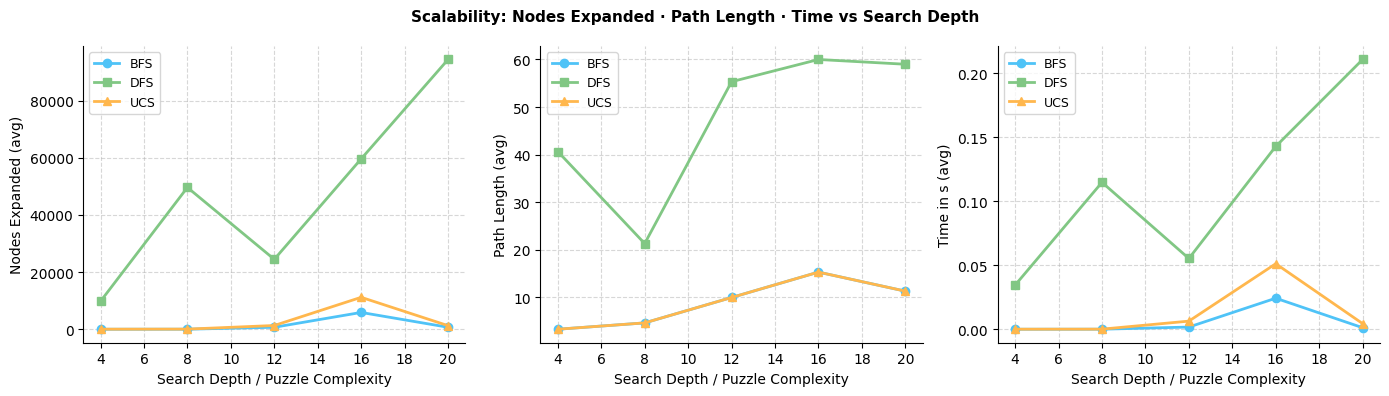
Run all three algorithms on a range of puzzles at increasing solution depths and plot how each metric scales.
# ─── Generate puzzles at known depths via random walks ────────────────────────
import random

def random_puzzle(num_moves=10, seed=None):
    """Generate a solvable puzzle by making `num_moves` random moves from the goal."""
    rng   = random.Random(seed)
    state = GOAL_STATE
    for _ in range(num_moves):
        neighbors = get_neighbors(state)
        _, state, _ = rng.choice(neighbors)
    return state

# ── Benchmark ─────────────────────────────────────────────────────────────────
depths      = [4, 8, 12, 16, 20]
seeds_each  = 3   # puzzles per depth level
DFS_LIMIT   = 60

data = {
    "depth"           : [],
    "algo"            : [],
    "nodes_expanded"  : [],
    "time_s"          : [],
    "path_len"        : [],
}

print(f"{'Depth':>6} {'Seed':>5} {'Algo':>5}  {'Nodes':>9}  {'Path':>6}  {'Time(s)':>9}")
print("-" * 50)

for d in depths:
    for seed in range(seeds_each):
        puzzle = random_puzzle(num_moves=d * 3, seed=seed * 100 + d)   # mix well
        if not is_solvable(puzzle):
            continue

        for algo_name, algo_fn in [("BFS", lambda p: bfs(p)),
                                    ("DFS", lambda p: dfs(p, DFS_LIMIT)),
                                    ("UCS", lambda p: ucs(p))]:
            r = algo_fn(puzzle)
            plen = len(r["path"]) if r["found"] else -1
            print(f"{d:>6} {seed:>5} {algo_name:>5}  {r['nodes_expanded']:>9,}  {plen:>6}  {r['time_s']:>9.4f}")
            data["depth"].append(d)
            data["algo"].append(algo_name)
            data["nodes_expanded"].append(r["nodes_expanded"])
            data["time_s"].append(r["time_s"])
            data["path_len"].append(plen)

print("\nBenchmark complete.")
 Depth  Seed  Algo      Nodes    Path    Time(s)
--------------------------------------------------
     4     0   BFS          2       2     0.0000
     4     0   DFS          3       2     0.0000
     4     0   UCS          4       2     0.0001
     4     1   BFS          3       2     0.0001
     4     1   DFS     14,696      60     0.0709
     4     1   UCS          9       2     0.0000
     4     2   BFS         52       6     0.0002
     4     2   DFS     14,690      60     0.0328
     4     2   UCS         99       6     0.0003
     8     0   BFS          8       4     0.0000
     8     0   DFS    144,103       4     0.3346
     8     0   UCS         17       4     0.0001
     8     1   BFS          2       2     0.0000
     8     1   DFS          3       2     0.0000
     8     1   UCS          4       2     0.0000
     8     2   BFS         92       8     0.0004
     8     2   DFS      4,785      58     0.0099
     8     2   UCS        160       8     0.0004
    12     0   BFS      1,081      12     0.0025
    12     0   DFS      5,343      56     0.0118
    12     0   UCS      2,035      12     0.0095
    12     1   BFS        991      12     0.0027
    12     1   DFS     41,374      50     0.0997
    12     1   UCS      1,837      12     0.0094
    12     2   BFS         54       6     0.0002
    12     2   DFS     26,722      60     0.0546
    12     2   UCS        103       6     0.0004
    16     0   BFS      2,698      14     0.0119
    16     0   DFS    111,308      60     0.2829
    16     0   UCS      5,130      14     0.0249
    16     1   BFS     12,368      18     0.0545
    16     1   DFS     19,631      60     0.0437
    16     1   UCS     23,522      18     0.1081
    16     2   BFS      2,622      14     0.0066
    16     2   DFS     47,943      60     0.1021
    16     2   UCS      4,916      14     0.0208
    20     0   BFS        878      12     0.0017
    20     0   DFS    143,051      -1     0.3568
    20     0   UCS      1,583      12     0.0061
    20     1   BFS        415      10     0.0008
    20     1   DFS     36,133      60     0.0653
    20     1   UCS        755      10     0.0018
    20     2   BFS        837      12     0.0014
    20     2   DFS    104,019      58     0.2103
    20     2   UCS      1,493      12     0.0056

Benchmark complete.
# ─── Plot scalability ─────────────────────────────────────────────────────────
import statistics

algo_names = ["BFS", "DFS", "UCS"]
palette    = {"BFS": "#4fc3f7", "DFS": "#81c784", "UCS": "#ffb74d"}
markers    = {"BFS": "o", "DFS": "s", "UCS": "^"}

fig, axes = plt.subplots(1, 3, figsize=(14, 4))
fig.suptitle("Scalability: Nodes Expanded · Path Length · Time vs Search Depth",
             fontsize=11, fontweight="bold")

for algo in algo_names:
    # Collect per-depth means
    means_nodes, means_path, means_time = [], [], []
    for d in depths:
        subset_n = [data["nodes_expanded"][i]
                    for i in range(len(data["depth"]))
                    if data["depth"][i] == d and data["algo"][i] == algo]
        subset_p = [data["path_len"][i]
                    for i in range(len(data["depth"]))
                    if data["depth"][i] == d and data["algo"][i] == algo and data["path_len"][i] >= 0]
        subset_t = [data["time_s"][i]
                    for i in range(len(data["depth"]))
                    if data["depth"][i] == d and data["algo"][i] == algo]

        means_nodes.append(statistics.mean(subset_n) if subset_n else 0)
        means_path.append(statistics.mean(subset_p) if subset_p else 0)
        means_time.append(statistics.mean(subset_t) if subset_t else 0)

    kw = dict(color=palette[algo], marker=markers[algo], linewidth=2, markersize=6, label=algo)
    axes[0].plot(depths, means_nodes, **kw)
    axes[1].plot(depths, means_path,  **kw)
    axes[2].plot(depths, means_time,  **kw)

for ax, ylabel in zip(axes, ["Nodes Expanded (avg)", "Path Length (avg)", "Time in s (avg)"]):
    ax.set_xlabel("Search Depth / Puzzle Complexity")
    ax.set_ylabel(ylabel)
    ax.legend(fontsize=9)
    ax.grid(True, linestyle="--", alpha=0.5)
    ax.spines[["top", "right"]].set_visible(False)

plt.tight_layout()
plt.show()
Part 7 — Summary & Key Takeaways
| Property | BFS | DFS | UCS |
|---|---|---|---|
| Data structure | Queue (FIFO) | Stack (LIFO) | Min-heap |
| Completeness | ✅ Yes | ⚠️ With depth limit | ✅ Yes |
| Optimality | ✅ Shortest path | ❌ No | ✅ Min-cost path |
| Time complexity | |||
| Space complexity | |||
| Best use case | Shallow solutions | Memory-constrained | Non-uniform step costs |
When to choose which algorithm?
BFS — when you need the guaranteed shortest solution and memory is not a constraint
DFS — when memory is limited or you just need any valid solution quickly (not necessarily shortest)
UCS — when step costs vary (e.g., different tiles have different move costs); generalises BFS
Next steps
Try Iterative Deepening DFS (IDDFS) — combines BFS optimality with DFS space efficiency
Add heuristics → A* search (informed search, much faster for hard puzzles)
Extend to the 15-puzzle (4×4) where uninformed search becomes impractical