
What You’ll Learn
Build simple AI agents (reflex, model-based, goal-based)
Prerequisites: Basic Python knowledge
Setup
Import required libraries for our implementations.
import numpy as np
import matplotlib.pyplot as plt
from collections import defaultdict
import random

# For reproducibility
np.random.seed(42)
random.seed(42)

print("✓ Libraries imported successfully!")
✓ Libraries imported successfully!
1. Simple Reflex Agent
A reflex agent makes decisions based only on the current percept (observation).
Example: Thermostat Agent
The agent reads room temperature and decides to turn heater on/off.
class ThermostatAgent:
    """Simple reflex agent that controls room temperature."""

    def __init__(self, target_temp=22):
        self.target_temp = target_temp

    def perceive(self, room_temp):
        """Get current room temperature."""
        return room_temp

    def act(self, room_temp):
        """Decide action based on current temperature."""
        if room_temp < self.target_temp:
            return "HEAT_ON"
        else:
            return "HEAT_OFF"

# Test the agent
agent = ThermostatAgent(target_temp=22)

print("Testing Thermostat Agent:")
print(f"Room at 18°C → {agent.act(18)}")
print(f"Room at 25°C → {agent.act(25)}")
print(f"Room at 22°C → {agent.act(22)}")
Testing Thermostat Agent:
Room at 18°C → HEAT_ON
Room at 25°C → HEAT_OFF
Room at 22°C → HEAT_OFF
Visualization: Agent Behavior Over Time
# Simulate room temperature over time
def simulate_thermostat(initial_temp, target_temp, steps=50):
    """Simulate thermostat agent controlling room temperature."""
    agent = ThermostatAgent(target_temp)

    temps = [initial_temp]
    actions = []

    current_temp = initial_temp

    for _ in range(steps):
        action = agent.act(current_temp)
        actions.append(1 if action == "HEAT_ON" else 0)

        # Simple temperature dynamics
        if action == "HEAT_ON":
            current_temp += 0.5  # Heating
        else:
            current_temp -= 0.3  # Cooling

        temps.append(current_temp)

    return temps, actions

# Run simulation
temps, actions = simulate_thermostat(initial_temp=18, target_temp=22)

# Plot results
fig, (ax1, ax2) = plt.subplots(2, 1, figsize=(10, 6), sharex=True)

# Temperature over time
ax1.plot(temps, 'b-', linewidth=2, label='Room Temperature')
ax1.axhline(y=22, color='r', linestyle='--', label='Target (22°C)')
ax1.set_ylabel('Temperature (°C)', fontsize=11)
ax1.legend()
ax1.grid(True, alpha=0.3)
ax1.set_title('Thermostat Agent Simulation', fontsize=13, fontweight='bold')

# Actions over time
ax2.fill_between(range(len(actions)), actions, alpha=0.5, color='orange')
ax2.set_xlabel('Time Steps', fontsize=11)
ax2.set_ylabel('Heater State', fontsize=11)
ax2.set_yticks([0, 1])
ax2.set_yticklabels(['OFF', 'ON'])
ax2.grid(True, alpha=0.3)

plt.tight_layout()
plt.show()

print(f"Final temperature: {temps[-1]:.1f}°C")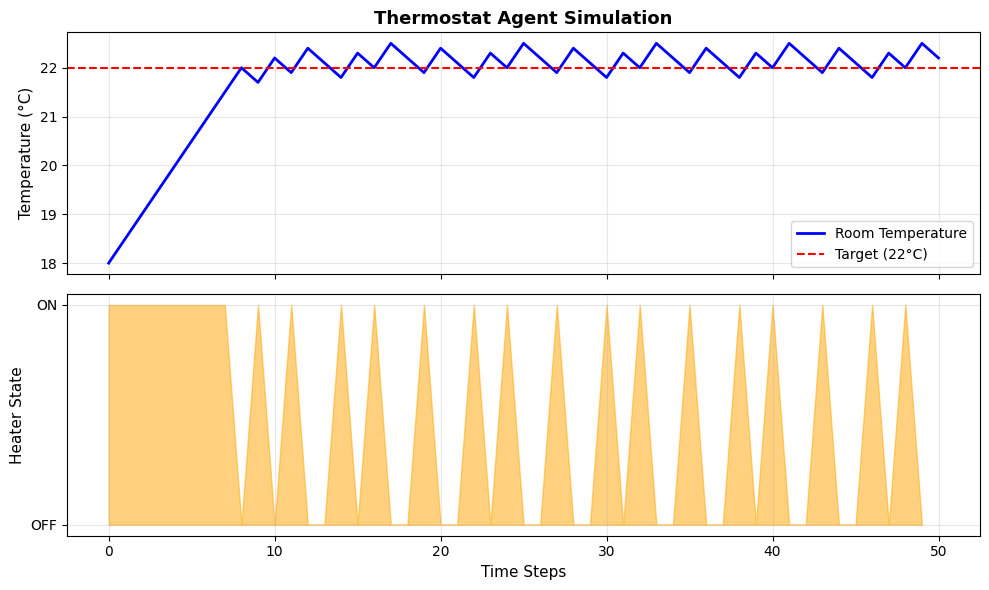
Final temperature: 22.2°C
Enhanced termostat agent with tolerance
To reduce frequent heater state switching, we can introduce a tolerance level.
import random
from typing import Dict, Any

class Environment:
    """Simple environment simulator"""
    def __init__(self, initial_temp: float = 20.0):
        self.temperature = initial_temp
        self.target_temp = 22.0

    def step(self, action: str) -> Dict[str, Any]:
        """Apply action and return new percept"""
        # Simulate temperature changes
        if action == 'heat':
            self.temperature += 0.5
        elif action == 'cool':
            self.temperature -= 0.5

        # Natural temperature drift
        self.temperature += random.uniform(-0.2, 0.2)

        return {
            'temperature': self.temperature,
            'target': self.target_temp
        }

class SimpleReflexAgent:
    """Agent that responds directly to percepts"""

    def __init__(self, tolerance: float = 1.0):
        self.tolerance = tolerance

    def perceive(self, percept: Dict[str, Any]) -> str:
        if(percept['temperature'] < percept['target'] - self.tolerance):
            return 'heat'
        elif(percept['temperature'] > percept['target'] + self.tolerance):
            return 'cool'
        else:
            return 'idle'

# Test your implementation
env = Environment(initial_temp=18.0)
agent = SimpleReflexAgent(tolerance=1.0)

print("Time\tTemp\tAction")
print("-" * 30)

for t in range(20):
    percept = {'temperature': env.temperature, 'target': env.target_temp}
    action = agent.perceive(percept)
    print(f"{t}\t{env.temperature:.1f}°C\t{action}")
    env.step(action)

print(f"\nFinal temperature: {env.temperature:.1f}°C")
Time Temp Action
------------------------------
0 18.0°C heat
1 18.6°C heat
2 18.9°C heat
3 19.3°C heat
4 19.7°C heat
5 20.3°C heat
6 20.8°C heat
7 21.5°C idle
8 21.3°C idle
9 21.3°C idle
10 21.1°C idle
11 21.0°C heat
12 21.5°C idle
13 21.3°C idle
14 21.2°C idle
15 21.2°C idle
16 21.3°C idle
17 21.1°C idle
18 21.2°C idle
19 21.3°C idle
Final temperature: 21.1°C
visualization of enhanced agent behavior
# Simulate enhanced agent behavior
def simulate_enhanced_agent(initial_temp, target_temp, tolerance, steps=50):
    """Simulate enhanced thermostat agent controlling room temperature."""
    agent = SimpleReflexAgent(tolerance)
    env = Environment(initial_temp)

    temps = [initial_temp]
    actions = []

    for _ in range(steps):
        percept = {'temperature': env.temperature, 'target': target_temp}
        action = agent.perceive(percept)
        actions.append(1 if action == "heat" else (0 if action == "idle" else -1))

        env.step(action)
        temps.append(env.temperature)

    return temps, actions
# Run simulation
temps, actions = simulate_enhanced_agent(initial_temp=18, target_temp=22, tolerance=1.0)
# Plot results
fig, (ax1, ax2) = plt.subplots(2, 1, figsize=(10, 6), sharex=True)
# Temperature over time
ax1.plot(temps, 'b-', linewidth=2, label='Room Temperature')
ax1.axhline(y=22, color='r', linestyle='--', label='Target (22°C)')
ax1.set_ylabel('Temperature (°C)', fontsize=11)
ax1.legend()
ax1.grid(True, alpha=0.3)
ax1.set_title('Enhanced Thermostat Agent Simulation', fontsize=13, fontweight='bold')
# Actions over time
ax2.fill_between(range(len(actions)), actions, alpha=0.5, color='orange')
ax2.set_xlabel('Time Steps', fontsize=11)
ax2.set_ylabel('Heater State', fontsize=11)
ax2.set_yticks([-1, 0, 1])
ax2.set_yticklabels(['COOL', 'IDLE', 'HEAT'])
ax2.grid(True, alpha=0.3)
plt.tight_layout()
plt.show() 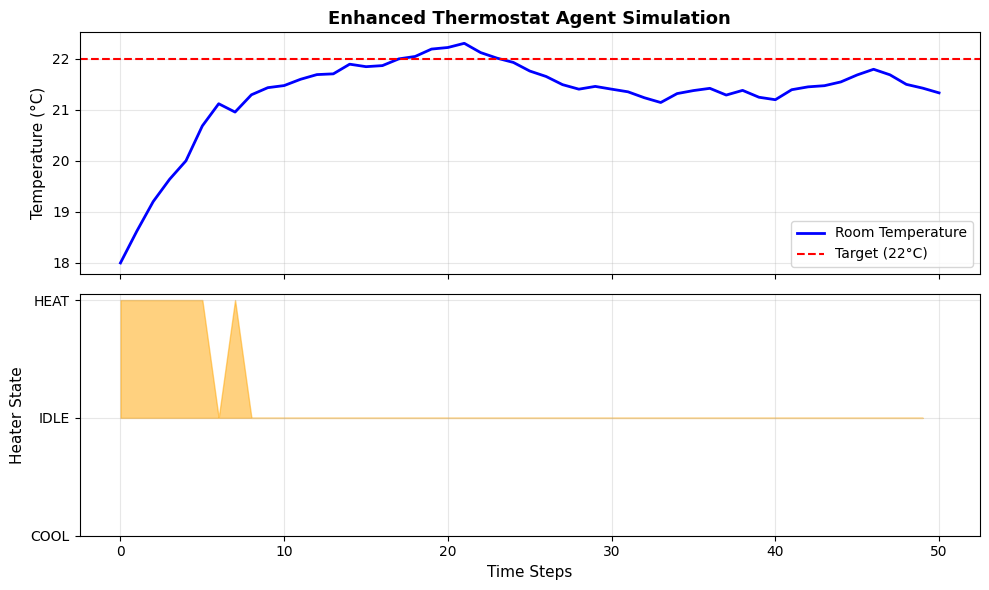
2. Model-Based Agent
A model-based agent maintains an internal state to track the world.
Example: Vacuum Cleaner Agent
The agent remembers which rooms it has cleaned.
class VacuumAgent:
    """Model-based vacuum cleaner agent."""

    def __init__(self, rooms):
        self.rooms = rooms  # List of room names
        self.current_room = rooms[0]
        # Internal model: track cleaned status
        self.cleaned = {room: False for room in rooms}

    def perceive(self, room_dirty):
        """Check if current room is dirty."""
        return room_dirty

    def act(self, room_dirty):
        """Decide action based on percept and internal state."""
        if room_dirty and not self.cleaned[self.current_room]:
            self.cleaned[self.current_room] = True
            return "CLEAN"
        elif all(self.cleaned.values()):
            return "DONE"
        else:
            # Move to next uncleaned room
            for room in self.rooms:
                if not self.cleaned[room]:
                    self.current_room = room
                    return f"MOVE_TO_{room}"
        return "IDLE"

# Test the agent
rooms = ['A', 'B', 'C']
agent = VacuumAgent(rooms)

# Simulate cleaning
print("Vacuum Agent Cleaning Process:")
room_status = {'A': True, 'B': True, 'C': True}  # All dirty

step = 1
while True:
    action = agent.act(room_status[agent.current_room])
    print(f"Step {step}: Room {agent.current_room} → {action}")

    if action == "DONE":
        break
    if action == "CLEAN":
        room_status[agent.current_room] = False

    step += 1
    if step > 10:  # Safety limit
        break

print(f"\nFinal state: {agent.cleaned}")
Vacuum Agent Cleaning Process:
Step 1: Room A → CLEAN
Step 2: Room B → MOVE_TO_B
Step 3: Room B → CLEAN
Step 4: Room C → MOVE_TO_C
Step 5: Room C → CLEAN
Step 6: Room C → DONE
Final state: {'A': True, 'B': True, 'C': True}